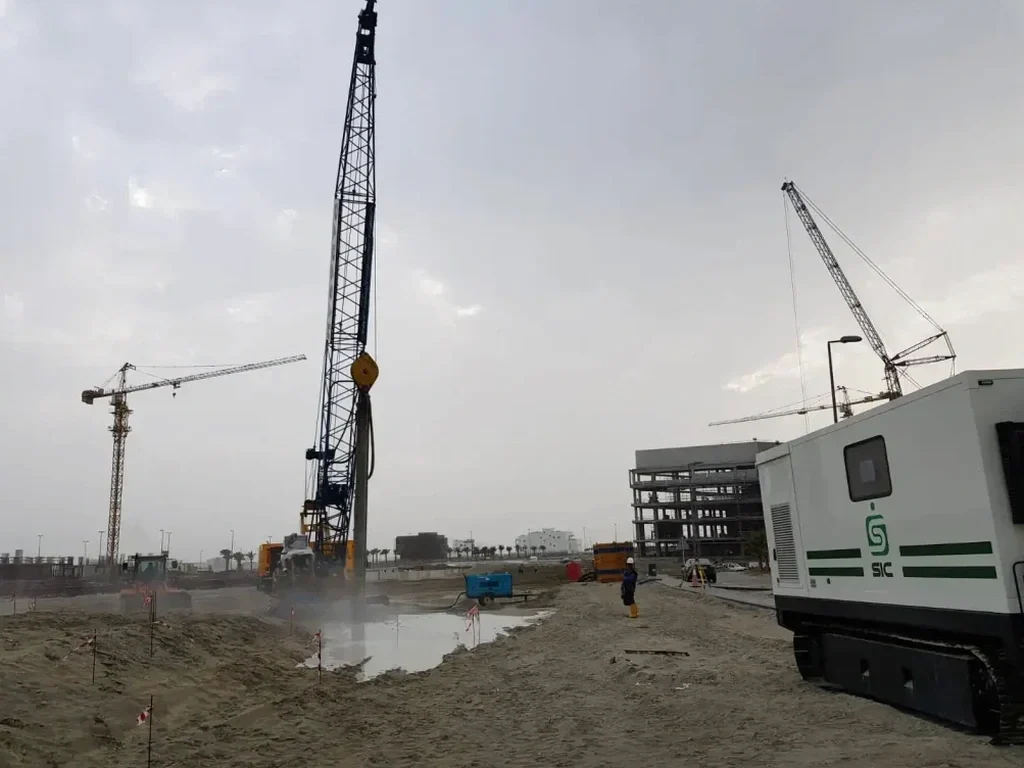
The 2015 Michigan Building Code, based on IBC, references ASCE 7 for minimum foundation bearing and settlement limits. In Grand Rapids that means dealing with the glacial outwash sands and loose silty fills left by the Grand River’s shifting course. Vibrocompaction design is a direct way to satisfy those code requirements without deep excavation or mass replacement. Our team has applied this method on industrial pads south of 28th Street and on riverfront parcels near the Sixth Street Bridge, where natural density was below 35% relative density. We specify vibrator frequency, probe spacing, and stage durations based on ASTM D1586 blow counts and grain-size curves from ASTM D2487. When the stratigraphy is more complex, we combine the vibrocompaction scope with a CPT test program to verify tip resistance before and after treatment.
A well-designed vibrocompaction grid in Grand Rapids glacial sand can take relative density from 35% to over 75% in a single pass, eliminating the need for deep foundations.
Site-specific factors
A depth vibrator in Grand Rapids is typically a 16-inch-diameter, 15-foot-long steel probe with an eccentric weight spinning at 1,800 rpm inside. The operator advances it under its own weight plus water flush, then withdraws it in controlled lifts. The real risk in this city is over-treating the surface crust while leaving the deeper sand loose. We see this on sites where the fill contains buried demolition debris from old furniture factories, which is common in the near-west side. The vibrator can deflect off a brick fragment and miss the loose zone entirely. Our design sequences specify real-time ammeter monitoring and stage withdrawal rates that prevent that. We also require post-treatment CPT soundings within 48 hours, because Grand Rapids’ high groundwater can delay pore pressure equalization and give falsely low early readings.
Regulatory framework
ASCE 7-16: Minimum Design Loads and Associated Criteria for Buildings and Other Structures, IBC 2015 (Michigan Building Code): Soils and Foundations, Section 1804, ASTM D1586: Standard Test Method for Standard Penetration Test (SPT) and Split-Barrel Sampling of Soils, ASTM D2487: Standard Practice for Classification of Soils for Engineering Purposes (Unified Soil Classification System), ASTM D4253/D4254: Standard Test Methods for Maximum and Minimum Index Density of Soils
FAQ
What does vibrocompaction design cost for a typical Grand Rapids commercial lot?
For a commercial parcel under one acre in Grand Rapids, the design scope including pre-treatment SPT borings, vibrocompaction grid specification, and post-treatment CPT verification generally falls between US$1,340 and US$4,700. The spread reflects site access, depth of treatment, and the number of verification soundings required by the geotechnical engineer of record.
How deep can vibrocompaction reach in Grand Rapids glacial sand?
In the clean outwash sands common along the Grand River valley, depth vibrators routinely reach 30 to 40 feet. The limiting factor here is not the vibrator power but the water table depth and the presence of cobble lenses that can stop probe advance.
Which Grand Rapids soil types are unsuitable for vibrocompaction alone?
Soils with more than 15 percent fines passing the No. 200 sieve respond poorly to vibratory densification. In Grand Rapids, that includes the silty clay layers found in the Belding outwash and the post-glacial lakebed sediments east of US-131. For those we shift to stone columns or compaction grouting.
How long after treatment can we start foundation work?
We require a minimum 48-hour waiting period after the last vibrator pass before running verification CPTs. In Grand Rapids’ sandy soil with shallow groundwater, excess pore pressures typically dissipate within three to five days, after which footings can be excavated and poured.