The soil profile beneath a project site in Heritage Hill often bears little resemblance to the ground conditions found just a few miles away in the industrial flats along Market Avenue. Grand Rapids sits on a complex glacial terrain shaped by the Lake Michigan lobe, and the contrast between well-compacted till and the soft silty clays of the Grand River floodplain can be dramatic. Running a Standard Penetration Test at multiple depths is the most direct way to quantify that difference. The procedure, governed by ASTM D1586, delivers N-values that correlate directly with relative density and consistency. In neighborhoods with century-old brick buildings or newly zoned mixed-use parcels, these numbers define whether shallow footings will work or whether deeper support becomes necessary. The city’s variable geology, with outwash sands and lacustrine deposits sitting within the same block, makes continuous sampling essential. A grain-size analysis often runs in parallel to classify the material recovered from the split spoon, giving the design team a complete picture of the subsurface before any concrete is poured.
SPT N-values in Grand Rapids glacial deposits can swing from 4 to 45 within 10 vertical feet — skipping the exploration means guessing which side of that range controls the design.
How we work
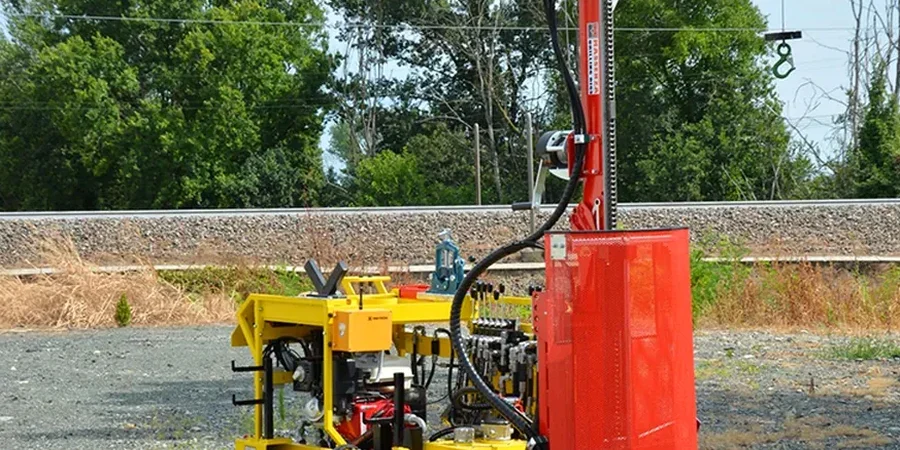
Glacial till in Kent County typically presents N-values above 30 below 15 feet, but the upper 10 feet can be a different story altogether. Post-glacial lake sediments and fill material near downtown Grand Rapids frequently yield blow counts under 8, a range that demands careful interpretation of settlement and bearing capacity. The SPT rig advances the boring with a 140-pound hammer dropping 30 inches, counting blows for each 6-inch increment of the 24-inch drive. We record the raw numbers and correct for overburden pressure using the standard N60 conversion. The test also recovers a disturbed sample in the split spoon, which goes immediately to the laboratory for visual classification and moisture content. In Grand Rapids, where the water table often sits within 8 to 12 feet of grade, the SPT spoon captures saturated fine sands that require liquefaction screening under the Kent County building code. The data feeds directly into bearing capacity equations and settlement analyses, providing the factual backbone for foundation recommendations.
Site-specific factors
The Kent County Building Code references IBC Chapter 18 and ASCE 7 for geotechnical investigation requirements, and in Grand Rapids the trigger is not just structural load but also soil variability. The Grand River has historically migrated across the valley floor, leaving buried channels of loose sand and organic silt that do not announce themselves at the surface. A foundation placed over one of these paleochannels without SPT data can expertise differential settlement that shows up within the first three freeze-thaw cycles. The secondary concern is liquefaction in the saturated fine sands mapped across the floodplain; N-values below 15 in these zones require further analysis under the simplified Seed-Idriss procedure. Borrow pits and old mill foundations, common in the city’s older industrial corridors, introduce another layer of risk: undocumented fill with brick, timber, and slag that produces erratic blow counts. Running the SPT at closer vertical spacing, sometimes every 2.5 feet through questionable material, is the only way to map these anomalies before excavation reveals them on a construction schedule.
FAQ
How much does an SPT boring program cost in Grand Rapids?
For a typical single-family or small commercial project in Grand Rapids, a two-boring program with SPT sampling at 5-foot intervals to 30 feet depth generally runs between $580 and $800 per boring, including mobilization within Kent County. The total depends on depth, access constraints, and whether laboratory testing on the recovered samples is included. A written proposal is provided after reviewing the site location and project scope.
How deep should SPT borings go for a Grand Rapids project?
The IBC requires borings to extend to a depth where the added stress from the structure is less than 10% of the existing overburden pressure, or to rock refusal. In Grand Rapids, where glacial till often provides competent bearing below 15 to 20 feet, most residential and mid-rise borings reach 30 to 40 feet. Taller structures or those with basement levels may require depths of 60 feet or more to assess the full stress bulb.
How are SPT N-values corrected for the Grand Rapids area?
Raw field N-values are converted to N60 using energy ratio corrections specific to the hammer and rig setup. In Grand Rapids, where the water table is often shallow, additional corrections for overburden pressure are applied to saturated fine sands and silts. The corrected N60 values are then used in bearing capacity and settlement calculations per the methods outlined in the IBC and the NAVFAC DM 7.1 manual.