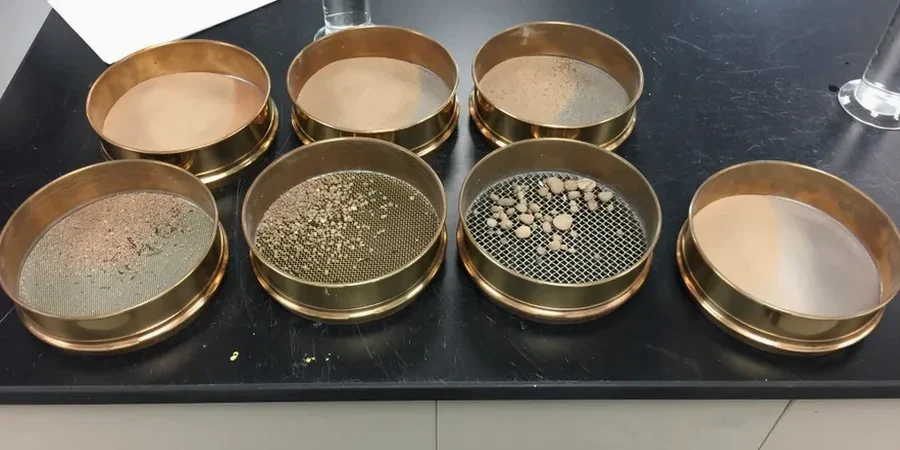
In Grand Rapids, more than a few foundation surprises trace back to the city's complex glacial drift. The mix of outwash sands and soft, gray lacustrine clays from the ancient Lake Michigan lobe creates sharp gradation changes across a single site. We run the full grain size curve—mechanical sieving plus hydrometer—to nail down the particle distribution. Without it, classification is just a guess. The hydrometer reading on those quiet clay fractions often explains why a footing trench holds water long after a rain. For projects near the Grand River floodplain, where sandy lenses sit atop fat clays, we recommend pairing this analysis with a deep excavation monitoring plan when cuts exceed 12 feet, because the soil behavior shifts dramatically with just a 5% change in fines content.
In Grand Rapids glacial soils, a 10% shift in clay fraction can flip the USCS classification from silty sand to clayey silt—and that changes the allowable bearing pressure by a factor of two.
Site-specific factors
Grand Rapids sits at roughly 640 feet above sea level, with a frost depth of 42 inches that drives foundation design across Kent County. The real risk isn't the cold—it's misclassifying a soil that contains 12% to 18% clay as a clean sand. Contractors who skip the hydrometer and rely only on a sieve stack will call it SW or SP. Place a footing on it, and after a wet spring, the clay matrix softens. Differential settlement follows. We've seen this pattern repeatedly in the Ridgewood and Eastown neighborhoods, where thin layers of glacial lake sediment lie just 6 feet below the surface. The grain size curve catches the clay tail that the eye misses. It's the difference between a 2,000 psf design and a 3,500 psf design under the Michigan Residential Code 2015, which adopts the IBC geotechnical provisions.
FAQ
How much sample do you need for a full sieve and hydrometer test?
We require about 1,500 grams of dry material for a complete analysis. For clean sands, 500 grams is often sufficient. If the soil contains gravel larger than 3/4 inch, we'll need closer to 5 kilograms to get a representative split. The lab can pick up samples from your Grand Rapids job site if you can't drop them off.
What's the cost range for a grain size analysis in Grand Rapids?
A standard sieve plus hydrometer package runs between US$110 and US$210 per sample, depending on whether you need the full hydrometer sedimentation curve or just the minus No. 200 wash. Volume pricing applies at 10+ samples from the same project.
Why does the hydrometer test take so long compared to just sieving?
The sedimentation process is governed by Stokes' Law—particles settle at a rate proportional to the square of their diameter. A 0.002 mm clay particle takes roughly 24 hours to fall 10 cm in water. There's no way to accelerate it without introducing error. We take readings over a full 24-hour period to build the lower end of the curve accurately.
Can you classify the soil for IBC-bearing capacity without a full grain size test?
A field identification by a geotechnical engineer can carry out a preliminary classification, but the IBC and Michigan Building Code require laboratory testing for final design values. The grain size analysis gives you the precise USCS symbol and the D-values needed to estimate permeability and frost susceptibility—both critical at Grand Rapids' 42-inch frost depth.