← Home · Foundations

Raft/Mat Foundation Design in Grand Rapids, Michigan

Together, we solve the challenges of tomorrow.

LEARN MORE →

Glacial Lake Chicago deposited up to 80 feet of soft, compressible clay across the Grand River valley, creating a foundation challenge that runs right through downtown Grand Rapids. When a site investigation reveals low undrained shear strength in these lake plain sediments, a conventional spread footing often becomes impractical. Raft or mat foundation design shifts the load distribution across a much larger footprint. The team prepares bearing capacity and settlement analyses that account for the preconsolidation pressure of the native clay, integrating data from the CPT test to map the depth to the波特兰 cement-like till that underlies much of Kent County. Every design package references the 2018 IBC and local amendments enforced by the Grand Rapids Building Safety Department.

A properly designed mat foundation in Grand Rapids lake plain clay can reduce differential settlement by over 60% compared to isolated footings on the same soil profile.

How we work

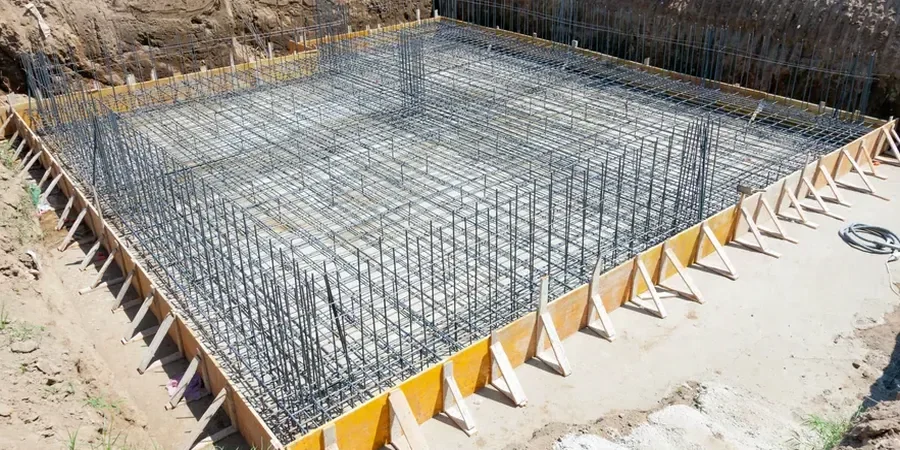
Grand Rapids averages over 60 inches of snowfall each winter, and the spring thaw saturates the upper clay crust for weeks. This seasonal moisture fluctuation demands a mat foundation that handles both the saturated bearing condition and the shrinkage that follows summer drying. The design process couples soil-structure interaction modeling with a detailed stratigraphic profile, often requiring the grain size analysis to distinguish the silty clay from the sand stringers that can act as drainage paths. Reinforcement layout follows ACI 318 guidelines, with bar spacing and depth verified against the modulus of subgrade reaction derived from field plate load data. The result is a rigid mat that bridges local soft spots without requiring deep ground improvement beneath the entire footprint.
Raft/Mat Foundation Design in Grand Rapids, Michigan
Technical reference image — Grand Rapids

Site-specific factors

Chapter 18 of the IBC requires a geotechnical investigation for any structure in Grand Rapids where the bearing stratum is not bedrock. The local risk is not simply excessive settlement but the presence of buried organics and peat lenses within the glacial lake deposits, which decompose over time and create voids under a rigid mat. A design that omits a thorough organic content scan risks long-term differential movement that no amount of reinforcement can correct. The engineering team cross-references historical soil maps from the Michigan Geological Survey with new borings to identify these pockets. Where the risk profile is unfavorable, the mat design is supplemented with sub-slab drainage and thickened edge beams to maintain structural integrity through the freeze-thaw cycles that dominate Michigan winters.

Need a geotechnical assessment?

Reply within 24h.

Email: contact@geotechnicalengineering1.org

Watch the video

Typical values

ParameterTypical value
Bearing pressure range1,500 – 3,000 psf (service)
Minimum mat thickness18 – 36 inches typical
Subgrade modulus (kₛ)50 – 150 pci (soft clay)
Frost depth consideration42 inches per Michigan Building Code
Reinforcement gradeASTM A615 Grade 60
Analysis methodFEM soil-structure interaction
Settlement tolerance1 inch total, 0.5 inch differential

Complementary services

01

Subgrade Modulus Determination

Field plate load tests and back-calculated k-values from CPT data to feed the structural model with site-specific stiffness parameters.

02

Settlement and Bearing Capacity Report

Consolidation analysis for the lake plain clay, including immediate and long-term settlement predictions under the full structural load.

03

Construction Support and Inspection

Subgrade preparation verification, mud-mat placement review, and reinforcement inspection before the concrete pour.

Regulatory framework

IBC 2018 (Michigan adoption) Chapter 18 – Soils and Foundations, ASCE 7-16 – Minimum Design Loads for Buildings and Other Structures, ASTM D1586 – Standard Penetration Test (SPT), ACI 318-19 – Building Code Requirements for Structural Concrete, Grand Rapids Building Safety Department – Local Geotechnical Submission Requirements

Frequently asked questions

What is the typical cost range for a raft foundation design in Grand Rapids?

Design fees for a raft or mat foundation in Grand Rapids generally fall between US$980 and US$3,580, depending on the building footprint, number of soil borings to integrate, and complexity of the soil-structure interaction model required by the structural engineer.

Why is a mat foundation often recommended over footings in downtown Grand Rapids?

The soft glacial lake clay beneath the Grand River corridor has low bearing capacity and variable thickness. A mat foundation bridges these inconsistencies and reduces differential settlement, which is critical for larger commercial buildings where isolated footings would require extensive ground improvement.

How does frost depth affect the mat foundation design in Michigan?

The Michigan Building Code specifies a 42-inch frost depth. The mat must be placed below this depth or be protected by rigid insulation. The design also accounts for the frost-susceptibility of the silty clay to prevent heave that could crack the slab.

What soil parameters do you need to start the raft design?

We require SPT N-values or CPT tip resistance with depth, Atterberg limits on the cohesive layers, moisture content, and unconfined compressive strength on any cohesive samples. Grain size data helps identify sand lenses that affect drainage and bearing response.

Do you provide the structural reinforcement drawings for the mat?

We deliver the geotechnical design parameters—allowable bearing pressure, subgrade modulus, and settlement curves—that the structural engineer uses to size the mat thickness and reinforcement. We coordinate directly with the structural team but do not stamp structural drawings.
Location and service area

We serve projects in Grand Rapids and surrounding areas.

View larger map