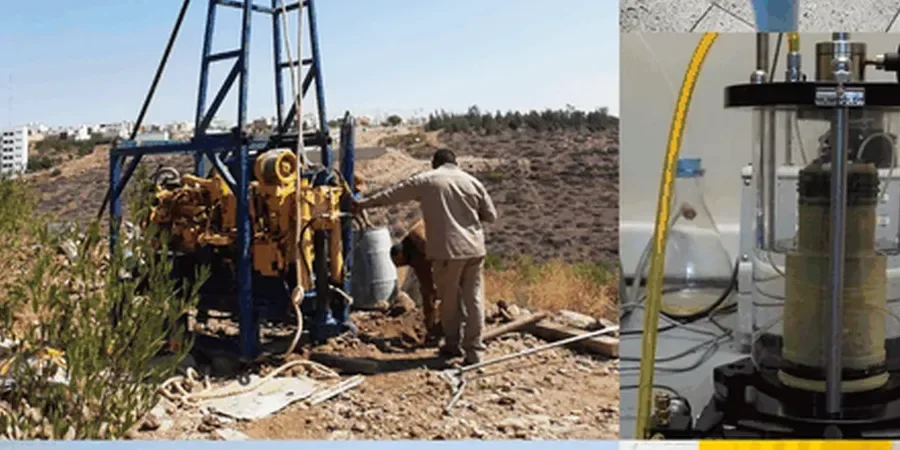
We recently completed a soil mechanics study for a five-story mixed-use building off Monroe Avenue, just north of downtown Grand Rapids. The developer was preparing to excavate to a depth of about 18 feet and had encountered an erratic mix of fine sand and stiff clay lenses during test pit observations. That kind of profile is common in the Grand River valley, where glacial outwash can shift from dense sand to soft lacustrine clay in less than 50 feet horizontally. Before we ever started the deep foundation design, we ran a full laboratory program including consolidation and shear strength tests to understand how these layers would behave under sustained load. In Grand Rapids, ignoring that heterogeneity is the fastest way to differential settlement problems. For sites where the upper ten feet are loose, we often recommend supplementing the soil mechanics study with stone columns to improve bearing capacity and reduce total settlement before placing footings.
The biggest variable in Grand Rapids is not the load, it is the undrained shear strength of the lacustrine clay — miss that by 10 percent and your settlement prediction can be off by a factor of two.
FAQ
How much does a soil mechanics study cost for a typical Grand Rapids commercial project?
For a commercial building site in the Grand Rapids area, a complete soil mechanics study — including Shelby tube sampling, triaxial and consolidation testing, and the engineering report — typically falls in the range of US$2,920 to US$5,820. The final cost depends on the number of borings, the depth of sampling, and the specific lab tests required by the geotechnical scope.
Which ASTM standards apply to a soil mechanics study in Michigan?
Our laboratory follows ASTM D2487 for soil classification, ASTM D4767 and D3080 for shear strength testing, ASTM D2435 for consolidation, and ASTM D4318 for Atterberg limits. Field sampling is conducted in accordance with ASTM D1587 for thin-walled tube sampling and ASTM D1586 for SPT correlation.
How long does it take to get results from the lab in Grand Rapids?
Standard turnaround is 10 to 14 business days from the date we receive undisturbed samples. Consolidation tests require the most time because each loading increment runs 24 hours. If the project schedule is tight, we can prioritize the shear strength report within 5 to 6 business days to support early foundation sizing.
Do you need a soil mechanics study if the Grand Rapids site already had an SPT investigation?
SPT data gives you relative density and consistency, but it does not carry out the direct measurement of friction angle, cohesion, or compressibility that a soil mechanics study delivers. For any structure with settlement-sensitive finishes or column loads above 100 kips, we strongly recommend running lab tests on undisturbed samples — the SPT alone leaves too much uncertainty in the Grand Rapids glacial stratigraphy.