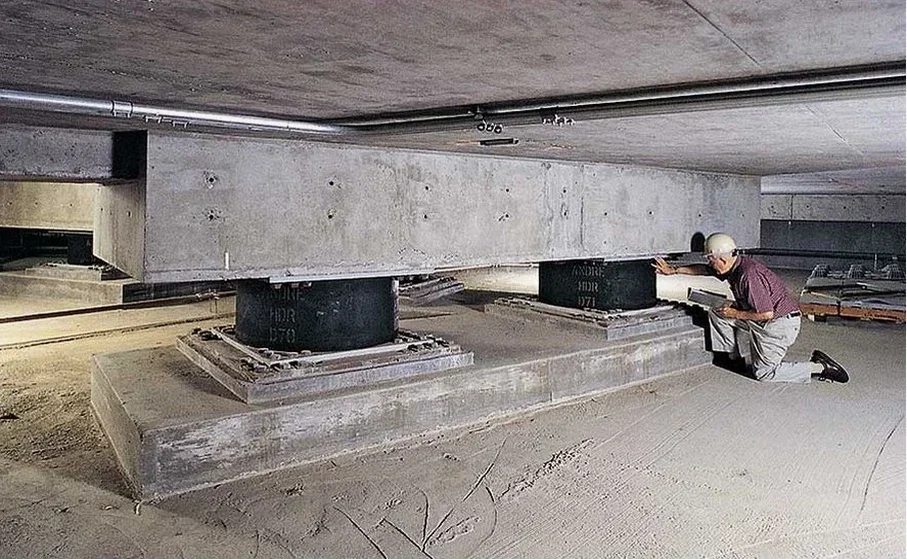
Grand Rapids sits on a complex glacial geology that shapes every seismic design decision. The city rests on the Marshall Sandstone formation, overlain by up to 300 feet of glacial till, outwash sands, and lacustrine clays deposited during the Wisconsin glaciation. This stratigraphy, combined with the moderate seismicity of the Michigan Basin, creates a specific challenge: soft soil amplification that can turn a distant earthquake into a damaging event for mid-rise structures. Although Michigan is not California, the New Madrid and Wabash Valley seismic zones pose a non-negligible threat, and base isolation seismic design offers an engineered solution. We apply the ASCE 7-22 Chapter 17 provisions to decouple the superstructure from ground motion, reducing spectral acceleration demands on the structural system. For sites near the Grand River, where loose alluvial sands dominate, we often integrate findings from a CPT test to refine the soil profile before finalizing the isolator parameters.
A well-designed isolation system reduces base shear by 60 to 80 percent compared to a fixed-base structure, transforming the seismic problem from strength to displacement control.
Site-specific factors
A five-story medical office building on 28th Street SE sits on 40 feet of loose-to-medium-dense outwash sand. The structural engineer designs a moment frame with an R-factor of 8, assuming fixed-base behavior. During the MCE event, the site amplification pushes spectral acceleration at 1-second period to 0.25g. The building experiences interstory drifts exceeding 2.5%, causing non-structural damage that renders the facility inoperable post-earthquake—precisely when the community needs it most. Base isolation seismic design directly addresses this scenario. By shifting the fundamental period to 3 seconds, we move the structure away from the amplified plateau of the response spectrum. The isolator displacement, not the superstructure ductility, absorbs the seismic energy. The critical risk lies in underestimating the moat wall clearance or neglecting the vertical component of near-field motions, which can induce rocking in sliding isolators. A peer review by a qualified independent team, as required by ASCE 7-22 §17.7, catches these oversights before construction begins.
FAQ
What is the typical cost of a base isolation seismic design for a Grand Rapids project?
For a mid-rise building in the Grand Rapids area, the engineering fees for a complete base isolation design package—including nonlinear time-history analysis, isolator specification, and peer review coordination—typically range from US$3,730 to US$7,820 depending on structural complexity and the number of ground motion suites required. This does not include the isolator hardware cost or prototype testing fees, which are separate and depend on the number and type of isolators specified.
Is base isolation necessary in a low-seismicity region like Michigan?
Necessity depends on the building's risk category and performance objectives. For essential facilities—hospitals, emergency operations centers, data centers—base isolation provides operational continuity after the MCE event. The 2011 Mineral, Virginia earthquake demonstrated that moderate events can damage unreinforced masonry and older concrete buildings across large distances due to efficient wave propagation in the North American craton. Grand Rapids structures on deep glacial soils face similar amplification risks.
What site investigation data is required before starting an isolation design?
We require a geotechnical report with shear wave velocity profiles (Vs30) to classify the site per ASCE 7-22 Chapter 20, site-specific response spectra if Site Class F is present, and bearing capacity and settlement estimates for the isolator pedestals. Deep borings extending at least 100 feet or to bedrock are essential in Grand Rapids due to the variable thickness of glacial deposits overlying the Marshall Sandstone.
How do you verify that the isolators will perform as designed?
ASCE 7-22 mandates a two-stage testing protocol. Prototype tests subject two full-scale isolators to the design displacement (D_M) for three cycles, plus additional cycles at increasing amplitudes up to the maximum considered displacement. Production tests verify every manufactured isolator at 1.0 D_M for three cycles under the design axial load. We witness these tests at the manufacturer's facility and review the hysteresis loops for conformance with the design properties before shipping.