A project on the sandy terraces east of the Grand River in Grand Rapids faces a completely different soil column than one near the clays of the Mill Creek valley. That sharp contrast is why a standard penetration test alone often leaves gaps in the stratigraphic picture. CPT testing bridges that gap by delivering a continuous digital signature of the subsurface. In a city where glacial outwash, lacustrine clays, and post-glacial alluvium can alternate within a few hundred feet, the cone penetration test provides the vertical resolution that foundation engineers in Grand Rapids rely on. We run the CPT rig through loose sands that can densify under seismic load, and through soft silts where settlement calculations demand accurate undrained shear strength values.
For sites near the medical mile or the expanding industrial corridors south of 28th Street, the CPT test data integrates directly with our laboratory program, including triaxial testing on Shelby tube samples, to validate parameters for shallow and deep foundation design.
CPT reveals the thin silt seams and loose sand lenses that standard borings often skip, and in Grand Rapids those details control settlement behavior.
How we work
The IBC 2021 references ASTM D5778 as the standard for electronic friction cone and piezocone testing, and in Grand Rapids that standard becomes especially relevant given the city's surficial geology. Much of the metro area sits on deposits of the Saginaw Lobe, with interbedded sands and silts that challenge traditional sampling methods. A 20-ton CPT rig pushes a 15 cm² cone at a constant 2 cm/sec, recording tip resistance, sleeve friction, and pore pressure every centimeter. This produces a nearly continuous profile that flags thin silt seams a split spoon would miss entirely.
The normalized soil behavior type chart by Robertson (1990, updated 2016) allows our team to classify soils in real time, distinguishing between a clayey silt and a silty clay without waiting for lab results. For Grand Rapids projects where groundwater is within 8 feet of grade, the piezocone element measures equilibrium pore pressure and dissipation rates. Combined with
sand cone density testing in the upper fill layers, the CPT data completes the geotechnical model from fill to bearing stratum.
Site-specific factors
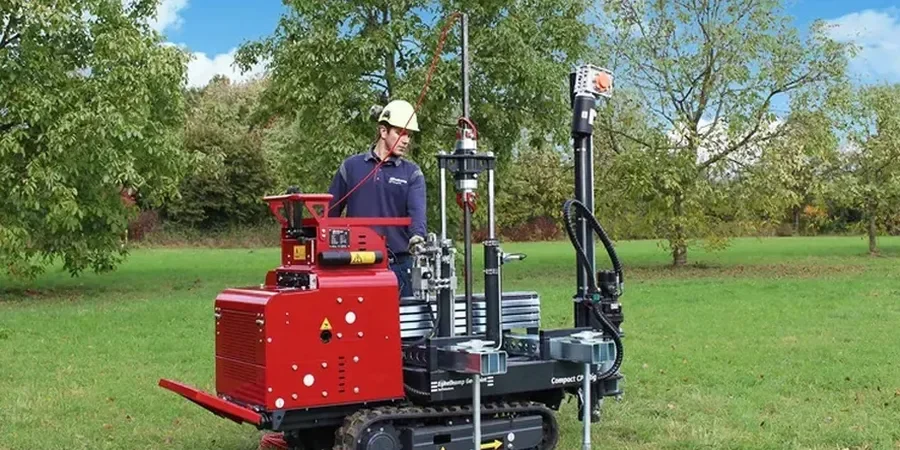
The 20-ton CPT truck positions its hydraulic rams over the push point, and the first meter tells you more about a Grand Rapids site than a drill rig's first ten feet of cuttings. We watch the real-time data stream: a sudden spike in tip resistance with a simultaneous drop in friction ratio signals a dense sand lens that could act as a bearing layer or a drilling obstruction. A flat response in a clay zone, followed by a rapid pore pressure rise, flags a normally consolidated silt that will settle more than the boring log suggests.
The primary risk in skipping CPT in Grand Rapids is missing thin, compressible layers within the glacial stratigraphy. A footing designed on SPT data alone may perform adequately, until a 4-inch silt seam at 12 feet depth consolidates differentially under sustained load. We have correlated local CPT data with laboratory consolidation tests to refine settlement predictions, and the residual risk drops substantially when the stratigraphic profile is continuous rather than sampled every 5 feet.
FAQ
What depth can CPT reach in Grand Rapids soils?
In the glacial sands and clays typical of Kent County, a 20-ton CPT rig typically reaches 60 to 80 feet before refusal. Refusal often occurs on dense gravel layers at the base of the glacial outwash, or on shale bedrock. We monitor sleeve friction and pore pressure continuously to gauge when refusal is approaching, and we never push beyond the safe capacity of the rods.
How does CPT compare to SPT for Grand Rapids projects?
CPT provides a continuous profile every centimeter, while SPT samples at 5-foot intervals. In Grand Rapids, where glacial stratigraphy can include thin silt seams and loose sand lenses, CPT captures features that SPT misses entirely. We often combine both methods: CPT for the continuous soil behavior profile and SPT borings where soil samples are needed for laboratory index testing.
What does a CPT test cost in Grand Rapids?
For most Grand Rapids projects, CPT testing runs between US$160 and US$280 per sounding meter, depending on mobilization distance, site access conditions, and whether piezocone or seismic cone is required. A typical single-day campaign with two 60-foot soundings provides comprehensive data for a standard building site.