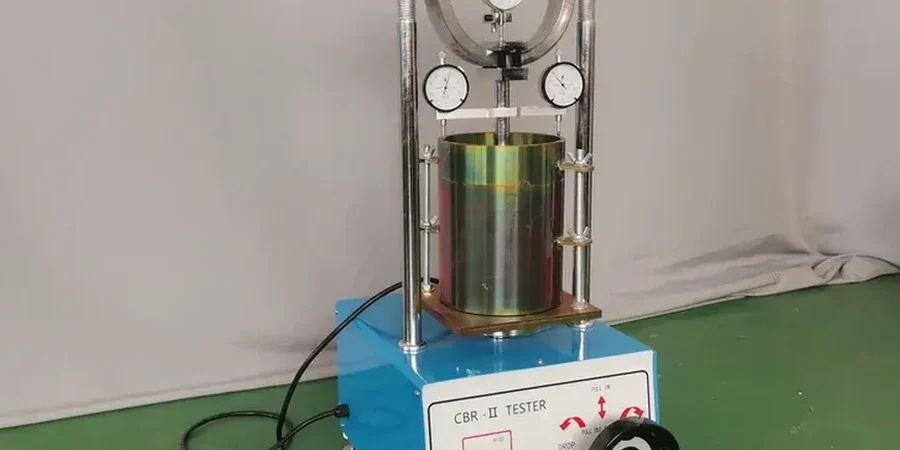
Glacial outwash and lacustrine clays define much of Grand Rapids' subsurface — remnants of Lake Michigan's ancient lobes that left behind silty, moisture-sensitive blends. Along the Grand River, groundwater hovers within 6 to 10 feet of grade, which means any pavement section faces a real fight against capillary rise and freeze-thaw cycling. The laboratory CBR test becomes a direct window into how the subgrade will behave once compacted and saturated, particularly for commercial pads east of US-131 and residential streets climbing into Kentwood. Unlike field estimates that shift with weather, a soaked CBR value measured under controlled compaction and surcharge loads gives the design team a repeatable number they can plug straight into the AASHTO 1993 pavement equation — and that's the kind of certainty Grand Rapids engineers lean on when Michigan winters chew up underbuilt sections. We often pair the lab CBR with a grain-size analysis to flag frost-susceptible silts before the pavement cross-section gets locked in.
A soaked CBR value below 3% in Grand Rapids glacial silt means you're designing a pavement that will pump water with every freeze-thaw cycle — stabilization is not optional at that point.
Site-specific factors
The loading frame we use for Grand Rapids projects is a screw-jack constant-rate machine, capable of pushing a 1.95-inch piston into a compacted specimen at exactly 0.05 inches per minute — slow enough to measure drained response, fast enough to finish the curve before the lab technician drinks his coffee cold. The real risk with CBR testing in western Michigan isn't the machine; it's the sample preparation. A field crew pulls a bulk sample from the bottom of a test pit, bags it, and if that soil dries out even partially before recompaction in the lab, the CBR number jumps 30 to 40 percent — and the pavement design ends up dangerously thin. We see this most often with the red-brown sandy clays common north of I-196. Those soils lose moisture fast in summer. Our lab maintains a strict chain of custody, runs moisture checks on arrival, and documents the compaction curve side-by-side with the CBR so any discrepancy between target density and achieved dry unit weight is visible in the report. Skipping the soak phase is another hazard; an unsoaked CBR might read 25%, but after four days submerged that same soil collapses to 4%, and that's the value the pavement actually feels come March.
Regulatory framework
ASTM D1883 – Standard Test Method for California Bearing Ratio (CBR) of Laboratory-Compacted Soils, ASTM D1557 – Standard Test Methods for Laboratory Compaction Characteristics of Soil Using Modified Effort, AASHTO T 193 – The California Bearing Ratio, ASTM D2487 – Standard Practice for Classification of Soils for Engineering Purposes (Unified Soil Classification System), MDOT Standard Specifications for Construction (current edition, sections on subgrade and subbase)
FAQ
How much does a laboratory CBR test cost in Grand Rapids?
A standard soaked CBR test (ASTM D1883) on a single point typically runs between US$120 and US$200, assuming the companion modified Proctor curve has already been established. If we need to develop the moisture-density relationship from scratch — which is common when the soil type is unknown — that adds to the scope. Three-point CBR curves for design (three moisture contents tested) sit at the upper end of the range. We carry out a written quote once we know the number of bulk samples and whether swell monitoring is required.
Why do you soak the sample for 96 hours? That seems excessive for a parking lot.
The 96-hour soak simulates the worst-case saturation the subgrade will ever see — and in Grand Rapids, with our high winter water table and spring thaw, that worst case happens every year. Even a parking lot subgrade sits within the capillary zone above groundwater. A soil that reads 20% CBR unsoaked can drop to 4% after saturation, and the pavement fails because the structural section was designed for the wrong number. The soaked value is the conservative, long-term strength that keeps the asphalt from cracking after the first wet season.
What CBR value do I need for a residential street in Kent County?
Kent County Road Commission and MDOT local agency standards generally look for a minimum soaked CBR of 5% to 6% in the top 12 inches of subgrade for low-volume residential streets. Below that, we often recommend 12 to 18 inches of aggregate base or a lime-stabilized subgrade layer to bridge the weak soil. The exact number depends on the projected traffic — a cul-de-sac serving ten homes has a different loading profile than a collector street with school bus traffic, and we adjust the design ESALs accordingly.
Can you run the CBR test on crushed concrete or recycled pavement material?
Yes, and we see more of that in Grand Rapids as MDOT and the city push for recycled aggregates in base courses. The challenge is that crushed concrete contains oversized particles that won't fit in a standard 6-inch CBR mold. We follow ASTM D1883's guidance on scalping material larger than 3/4 inch and note the percentage removed in the report. The resulting CBR is valid for design but must be interpreted together with the gradation data, because the scalped fines govern the soaked strength.