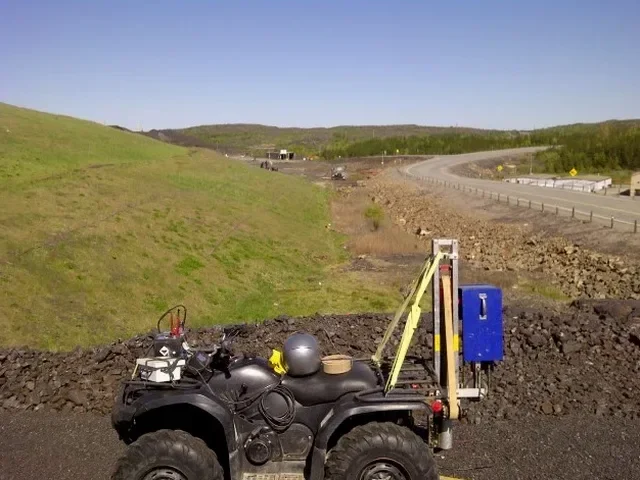
A commercial development near the Grand River hit refusal during test drilling at 12 feet—contractors suspected shallow bedrock but had no idea the surface was irregular and riddled with solution cavities typical of the Michigan Basin’s gypsum strata. We deployed a 24-channel geophone spread and ran a refraction line straight across the site. The velocity contrast between the saturated glacial outwash and the underlying Coldwater Shale was sharp enough to map the rockhead within 6 inches of accuracy. Subsurface surprises get expensive fast in Grand Rapids, where the Pleistocene sediment package varies from dense till to loose lacustrine sand over just a few hundred feet. Seismic tomography gives you a continuous velocity cross-section instead of isolated point data, revealing buried channels, weathered zones, and abrupt lateral changes that standard borings miss. For projects near the city’s northeast side, where karst features are documented, we often combine this with a resistivity survey to cross-check low-velocity anomalies that could be voids rather than just soft clay.
A 600-foot refraction line in Grand Rapids can resolve bedrock depth every 5 feet laterally—no other method delivers that density of subsurface information in a single day of fieldwork.
Site-specific factors
ASCE 7-22 and the Michigan Building Code require Site Class determination for Seismic Design Category assignment. In Grand Rapids, where glacial stratigraphy changes abruptly, assuming Site Class D when you actually have a stiffer Site Class C profile can add unnecessary foundation costs. Worse, missing a deep soft clay pocket and classifying as C when the Vs30 falls below 600 ft/s creates a non-conservative seismic design. The 2015 Michigan Geological Survey report on abandoned gypsum mines beneath the city documents collapses and sinkholes concentrated along the Plaster Creek corridor and parts of Wyoming Avenue. A refraction survey cannot directly image an air-filled void, but it detects the fractured halo and velocity drop around a cavity before collapse migrates to the surface. Ignoring these features during due diligence exposes developers to structural settlement, groundwater intrusion, and expensive emergency grouting.
Regulatory framework
ASTM D5777-18: Standard Guide for Using the Seismic Refraction Method, ASCE 7-22: Minimum Design Loads and Associated Criteria for Buildings and Other Structures, Chapter 20, IBC 2021: International Building Code, Section 1613 on Earthquake Loads and Site Classification, ASTM D7128-18: Standard Guide for Using the Seismic-Reflection Method for Shallow Subsurface Investigation, Michigan Building Code 2015 (with Grand Rapids amendments): Geotechnical investigation requirements for foundation design
FAQ
How long does a seismic refraction survey take on a typical Grand Rapids lot?
A standard 300-foot refraction line with 24 geophones takes about three to four hours of field time, including setup, shooting, and breakdown. Data processing and interpretation add one to two business days. Larger sites with multiple lines or restricted access near downtown can extend fieldwork to a full day or more.
What does seismic tomography cost for a geotechnical project in Grand Rapids?
Depending on the number of lines, site accessibility, and depth of investigation required, budgets typically range from US$2,390 to US$5,800. A single line for bedrock depth and Vs30 runs at the lower end. Multiple intersecting lines with reflection profiling and a full velocity model push toward the upper end.
Can you survey a paved site without breaking the surface?
Yes. We use an accelerated weight drop source that sits on the pavement surface and generates a repeatable impulse without damaging asphalt or concrete. Geophones are planted in soil strips or fastened with plates on hard surfaces. This works well for parking lots, warehouse slabs, and urban infill sites throughout Grand Rapids.
What is the difference between MASW and seismic refraction for site classification?
Refraction measures compressional-wave velocity and can derive shear-wave velocity through Poisson’s ratio assumptions, giving a continuous bedrock profile. MASW directly measures shear-wave velocity and works even when a velocity inversion exists that would defeat refraction. For IBC Site Class determination, we often recommend running both lines on the same spread to cross-validate the Vs30 result.