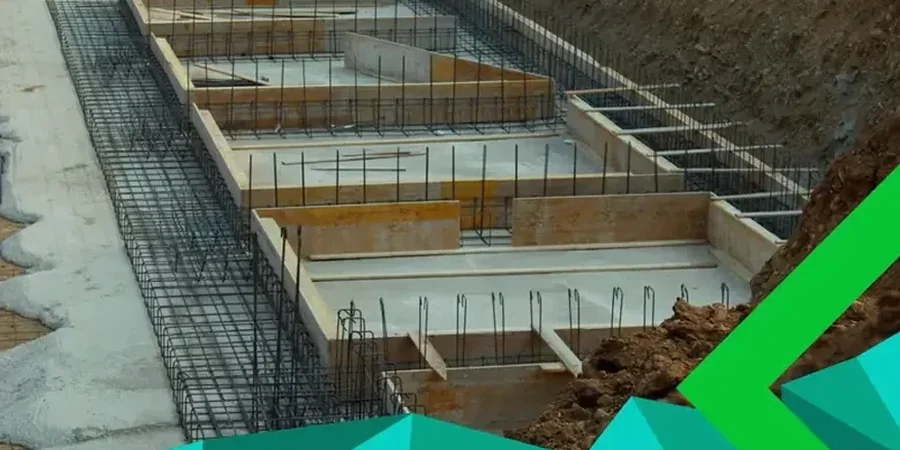
Grand River clay does not read the textbook. The soil under Grand Rapids shifts character block by block—glacial outwash sand near the river, dense till east of the Beltline, and pockets of compressible silts that can surprise even experienced excavators. We learned years ago that shallow foundation design here starts with understanding the Laurentide ice sheet’s deposit patterns. A footing that works on Michigan Street may need a completely different bearing width three miles north in Plainfield Township. The frost depth in Kent County reaches 42 inches. That fact alone rules out shallow approaches that work fine in southern Indiana. Our team pairs local drilling records with ASTM D1586 SPT data and laboratory consolidation tests to size footings and mat foundations that stay within allowable settlement limits. When the soil profile is erratic, we often combine the shallow foundation analysis with a standard penetration test campaign to map refusal depth across the site before committing to final dimensions.
Grand Rapids glacial soils can lose 40% of their bearing capacity with a 2-foot rise in groundwater—we check the seasonal high every time.
How we work
Grand Rapids sits at roughly 640 feet elevation on a river terrace carved through Devonian bedrock. The city’s 200,000 residents live on a mix of sandy loam, clay lenses, and occasional cobble layers that complicate shallow bearing estimates. In our experience, the most common call we get is for a spread footing under a two-story addition in the Heritage Hill district—old homes, tight lots, and basement excavation limits that demand precision. A typical project starts with hand-auger borings or machine-drilled SPT holes at 5-foot intervals. We classify the material per ASTM D2487, run Atterberg limits on the fines, and select a bearing capacity approach. For granular soils we lean on Terzaghi’s general shear model with a factor of safety of 3.0. For cohesive layers we check undrained shear strength and account for long-term settlement. When groundwater is within 5 feet of the base, buoyant unit weight corrections become non-negotiable. Every design package references the IBC 2021 Chapter 18 and the ASCE 7-22 load combinations. No generic assumptions. The Grand River floodplain demands site-specific reasoning.
FAQ
How much does a shallow foundation design package cost in Grand Rapids?
For a typical residential or light commercial project in Kent County, the geotechnical investigation and shallow foundation design report runs between US$1,610 and US$3,150. The range depends on the number of borings, laboratory testing required (consolidation, Atterberg limits, grain size), and whether groundwater monitoring is needed. A single-family home addition with two borings and a concise bearing capacity letter falls at the lower end. A commercial mat foundation with settlement analysis and multiple SPT borings moves toward the upper end.
What soil information is required before designing a shallow foundation in Grand Rapids?
At minimum, we need SPT N-values at 2.5-foot intervals down to at least 10 feet below the proposed bearing elevation. We also run moisture content, Atterberg limits on fines, and grain-size distribution per ASTM D2487. If the site is within the Grand River floodplain or near a known fill area, we add consolidation tests on Shelby tube samples to estimate settlement rate and magnitude. Groundwater depth measured during drilling is essential.
How does the frost depth affect shallow foundation design in Michigan?
Kent County’s frost depth reaches 42 inches. Any shallow foundation must have its bearing surface below that line, or it must be protected by rigid insulation per ASCE 32. We typically specify footing bottom at 48 to 54 inches to carry out a margin. Frost heave in silty soils can lift an unheated garage footing over an inch in one winter if the depth is insufficient, so the depth is not negotiable.
Can you design a shallow foundation on fill soil in Grand Rapids?
It depends on the fill composition and compaction. We probe the fill with a dynamic cone penetrometer and compare blow counts to native soil below. If the fill is granular, at least 5 feet thick, and compacted to 95% of modified Proctor, a shallow footing may be feasible with a reduced bearing pressure. If the fill contains organics, brick rubble, or variable debris—common in older Grand Rapids lots—we usually recommend overexcavation and engineered fill replacement before footing construction.
What is the difference between a mat foundation and a spread footing?
A spread footing supports individual columns or walls. A mat foundation is a continuous slab that supports the entire structure. We specify mats when soil bearing is marginal across the footprint, when differential settlement must be minimized, or when the water table is high and a single rigid slab helps manage buoyancy and soil-structure interaction. In Grand Rapids, mats are common on sandy sites east of US-131 where soil stiffness varies over short distances.