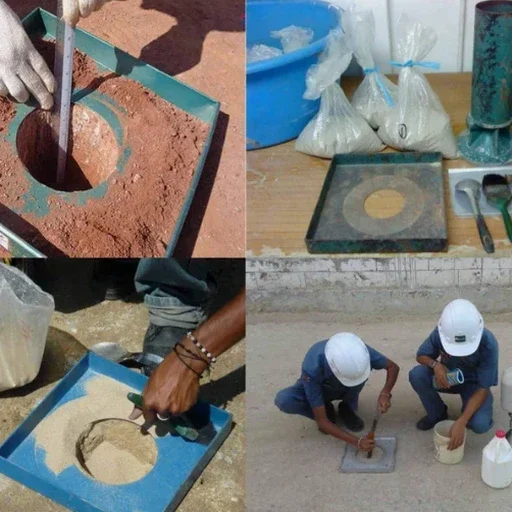
A recent warehouse expansion off Patterson Avenue required verification of subgrade compaction beneath a heavily loaded concrete slab. The geotechnical report specified 98 percent of modified Proctor density, and the only way to confirm that number was with a direct sand cone density measurement taken at the bottom of each lift. In Grand Rapids, where glacial outwash sands and silty clays alternate unpredictably, nuclear gauge correlations can drift when the moisture content shifts by more than a few percent. That is why our field crews carry calibrated sand cone kits alongside the nuclear gauge — the sand cone becomes the referee test when numbers do not align. For earthwork contractors working under the Grand Rapids building permit program, a properly executed ASTM D1556 test provides the defensible documentation that compaction has met both the project specification and the Michigan Building Code’s earthwork provisions. The sand cone does not require a special nuclear safety plan, which simplifies access to occupied job sites, and it works in trenches where gauge placement is impossible.
A sand cone test gives you a number a judge will accept — a direct measurement of density that requires no radiation source and correlates cleanly with the Proctor curve.
How we work
Grand Rapids sits on a complex glacial stratigraphy: the Saginaw Lobe deposited sands, gravels and clay-rich tills that can change from granular to cohesive within a single building footprint. When fill is placed across these transitions, differential settlement becomes a real concern, and the compaction acceptance criteria need to be verified on each soil type separately. The sand cone method, run according to ASTM D1556 and referenced in the IBC Chapter 18, measures in-place density directly by excavating a small hole, capturing all removed soil, and measuring the volume with calibrated Ottawa sand. Unlike a nuclear gauge, the sand cone is insensitive to soil chemistry, organic content and interference from buried utilities. When the project includes structural fills under
footings or retaining walls, we often pair the sand cone with laboratory Proctor curves to confirm that the field density meets the 95 or 98 percent threshold. Our Grand Rapids lab maintains dedicated compaction molds calibrated to MDOT and local agency mix designs so the Proctor reference is always specific to the material being placed on site. The method is straightforward but technique-sensitive: the base plate must sit flush on uneven ground, the excavation depth must match the lift thickness, and the sand pouring must be steady to avoid jarring that would densify the calibration sand.
Site-specific factors
Grand Rapids grew along the Grand River, and much of the downtown core and older industrial corridors are built on historical fill that contains brick fragments, wood debris and undocumented ash layers. When a contractor assumes uniform density across a site with that kind of history, the result can be a slab that develops settlement cracks within the first freeze-thaw cycle. One of the most expensive mistakes we see is accepting density results from a nuclear gauge that was calibrated on clean sand but used on fill with high iron content or slag — the gauge can read 5 to 8 percent high, and the owner only discovers the problem when the floor begins to dish. The sand cone method eliminates that error by measuring mass and volume directly. On MDOT-funded roadway projects through Kent County, failing a sand cone test on a subbase lift means the entire lift must be reworked before the next course is placed, and that delay costs far more than the testing itself. The true risk is not the test cost but the schedule and liability exposure when compaction is accepted without direct verification.
FAQ
How much does a sand cone density test cost in Grand Rapids?
A single sand cone field density test in the Grand Rapids area typically runs between US$90 and US$140 per point, depending on the number of tests per mobilization and the travel distance from our Grand Rapids lab. Most earthwork projects require a minimum of four to six tests per day to make mobilization cost-effective, and we offer day-rate pricing when the test count exceeds ten points.
When does the Grand Rapids building department require a sand cone test instead of a nuclear gauge?
The sand cone is typically required when the nuclear gauge cannot be correlated reliably, which happens on soils with high organic content, slag fill or scattered demolition debris common in older Grand Rapids neighborhoods. The building department may also require sand cone verification points on any lift where the nuclear gauge reading is within 2 percent of the rejection threshold, to carry out a direct measurement that does not rely on a calibration curve.
How deep does the sand cone excavation need to go?
The excavation depth should match the compacted lift thickness, which on most Grand Rapids commercial projects is 8 to 12 inches loose, compacting to 6 to 8 inches. For thin pavement base courses of 4 inches, we use a reduced-volume procedure with a smaller base plate opening and a finer calibration sand to maintain accuracy.
Can you test density in trench backfill with the sand cone?
Yes, the sand cone method works well in trenches and around utility installations where a nuclear gauge cannot be positioned safely or where the trench width is insufficient for gauge placement. We use a base plate that bridges the trench and excavate through the plate opening, capturing all material for mass determination regardless of the confined space.