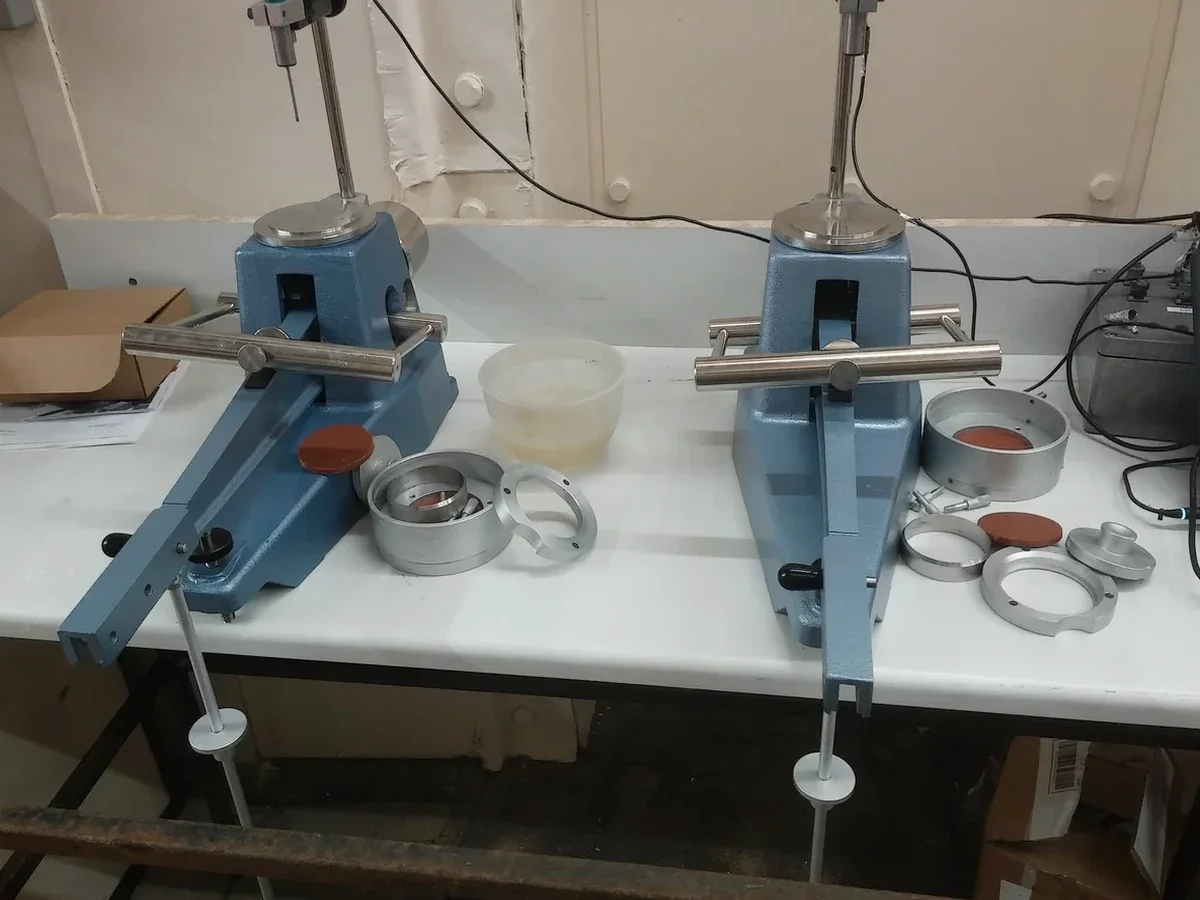
Working with the clays and silts across Grand Rapids requires more than just a visual classification. We consistently see projects along the Grand River floodplain where the soil behavior changes dramatically with moisture content—what looks stable in August can turn plastic by October. The Atterberg limits test defines those critical transitions between liquid, plastic, and semisolid states. It is the single most practical index test for predicting how a fine-grained soil will perform under load, during excavation, or beneath a pavement section. Many local geotechnical reports pair it with grain size analysis to build a complete picture of the deposit, especially in the mixed glacial tills that dominate Kent County. Our lab runs the test per ASTM D4318, delivering results that contractors and structural engineers can actually use for estimating settlement potential, shrink-swell behavior, and construction trafficability.
A plasticity index above 25 in Grand Rapids clay almost always signals a shrink-swell risk that standard spread footings cannot ignore.
How we work
The surficial geology of Grand Rapids is a direct product of the Lake Michigan lobe of the Wisconsin glaciation, leaving behind lacustrine clays, outwash sands, and a patchy mantle of loess in the uplands. This means plasticity can vary over short distances—a boring on one side of Fulton Street might hit lean clay (CL), while three hundred feet west you encounter a fat clay (CH) with a liquid limit above 50. We determine the liquid limit using the Casagrande cup method and the plastic limit by hand-rolling threads at the precise moisture content where the soil crumbles. The numerical difference gives the plasticity index, a direct indicator of the soil's affinity for water and its volume-change potential. For deep excavations near downtown, we often recommend complementing Atterberg data with a
slope stability analysis, particularly when the Grand River level is high and the plasticity index exceeds 20. The test also feeds directly into the USCS classification (ASTM D2487), which governs everything from allowable bearing capacity to pavement design inputs. For road projects on plastic subgrades, the liquid limit and plasticity index are mandatory parameters in the Michigan DOT HMA pavement design procedure, and we routinely cross-check them with
CBR testing to validate the structural section.
Site-specific factors
The most common mistake we see in Grand Rapids is assuming that a stiff, dry clay in July will behave the same way in November. When a contractor skips Atterberg testing and bases foundation decisions solely on blow counts, they miss the real mechanism of failure: moisture-driven volume change. A highly plastic clay can heave a slab or cause pavement rutting within two freeze-thaw cycles. The risk multiplies in the city's older neighborhoods, where residential foundations were often placed on unclassified fill that contains pockets of high-plasticity material. Without knowing the liquid limit and plasticity index, there is no reliable way to design for drainage, select appropriate backfill, or specify the correct compaction moisture range. The International Building Code (IBC) and ASCE 7 require soil classification for any structure in Seismic Design Category B or higher, which includes Grand Rapids. Overlooking this test is not just a technical oversight—it is a liability that can lead to differential settlement claims and premature pavement distress.
Regulatory framework
ASTM D4318: Standard Test Methods for Liquid Limit, Plastic Limit, and Plasticity Index of Soils, ASTM D2487: Standard Practice for Classification of Soils for Engineering Purposes (Unified Soil Classification System), ASCE 7: Minimum Design Loads and Associated Criteria for Buildings and Other Structures, IBC (International Building Code) Chapter 18: Soils and Foundations, Michigan DOT Standard Specifications for Construction
FAQ
What is the cost of Atterberg limits testing in Grand Rapids?
A standard Atterberg limits test (liquid limit and plastic limit) on one sample typically runs between US$60 and US$100, depending on sample condition, preparation requirements, and turnaround time. Multi-sample projects or rush requests may adjust the unit price. Contact our lab with the number of samples and we will carry out a firm quote.
How long does it take to get results from an Atterberg limits test?
Most samples are completed within 2 to 4 business days. The test requires drying, pulverizing, and hydrating the soil to the correct consistency, plus multiple determinations for both the liquid and plastic limits. Expedited same-day or next-day reporting is available for active construction projects where excavation or fill placement is waiting on classification data.
Does my Grand Rapids project really need Atterberg testing if I already have SPT blow counts?
Yes. Blow counts tell you about relative density or consistency, but they do not classify the soil or predict its volume-change potential. A stiff clay with a high plasticity index can carry high blow counts yet still heave or soften significantly with moisture changes. Atterberg limits carry out the mineralogical and behavioral data that blow counts alone cannot.
What is the minimum sample size required for the test?
We need approximately 300 to 500 grams of material passing the No. 40 (425 µm) sieve. For most Grand Rapids clays, a standard 3-inch Shelby tube sample or a one-gallon bag of disturbed cuttings from the target depth is sufficient. Samples should be sealed to preserve field moisture content if the liquidity index is also required.