← Home · Slopes & Walls

Retaining Wall Design in Grand Rapids, MI: Soil Data That Drives Stability

Together, we solve the challenges of tomorrow.

LEARN MORE →

The soil profile shifts fast when you cross the Grand River. On the west side near John Ball Park, you hit dense sand and gravel outwash. Move east toward the Fulton Heights area, and the footing of a retaining wall design rests on stiff clay till with cobbles. We have pulled Shelby tubes from both sides of Grand Rapids in the same week and seen friction angles swing by 8 degrees. For a retaining wall design on a sloping lot near Lookout Park, that difference controls the failure mode. We run ASTM D4767 triaxial tests to lock in drained strength parameters, and we combine that with the CPT test when access is tight and continuous stratigraphy matters. No two blocks in this city share the same glacial history, so every retaining wall design starts with a boring log, not an assumption.

In Grand Rapids, the difference between a 30-year wall and a 5-year failure often sits in 3 ft of silty sand that nobody cored.

How we work

The most common error we see in Grand Rapids is designing a cantilever wall on near-shore sands without checking for seepage forces. A contractor will pull a conservative bearing pressure from a generic geotech report, size the stem and heel, and then wonder why the wall tilts after the first wet spring. The problem is not bearing capacity; it is groundwater. In neighborhoods like Riverside Gardens, the water table sits just 6 ft down in April. We run in-situ permeability tests through screened piezometers to feed a flow net into the retaining wall design. That data goes straight into the IBC Section 1806 analysis. When the wall has to resist hydrostatic pressure plus backfill surcharge, we often recommend a piles solution to carry the stem load into the deeper, drier till.
Retaining Wall Design in Grand Rapids, MI: Soil Data That Drives Stability
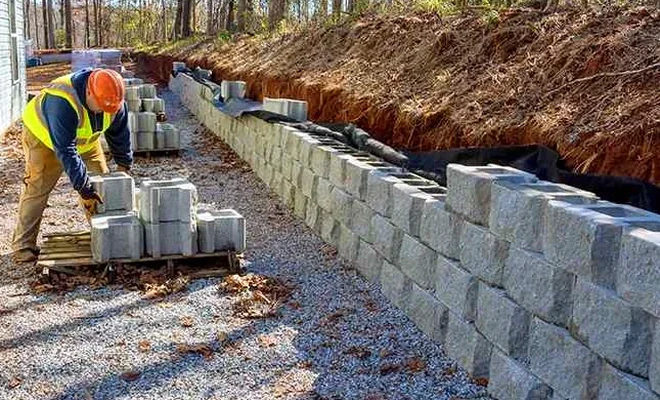
Technical reference image — Grand Rapids

Site-specific factors

In Grand Rapids, we often see walls built in August that look perfect until the first January thaw. The issue starts in the backfill. If the contractor places clay-rich site soil instead of a free-draining granular fill, the wall becomes a dam. Water builds up behind the stem, freezes, and exerts lateral pressures that Coulomb's equation never predicted. We have measured pore pressure spikes of 300 psf inside the backfill zone after a snowmelt event near Plaster Creek. That is why our retaining wall design always includes a drainage specification: a 12-inch gravel chimney, a perforated toe drain, and a filter fabric wrap. Without it, even a wall with a safety factor of 2.0 against sliding can move.

Need a geotechnical assessment?

Reply within 24h.

Email: contact@geotechnicalengineering1.org

Typical values

ParameterTypical value
Internal friction angle (sand outwash)32° to 38° (drained)
Undrained shear strength (clay till)800 to 1,500 psf
Maximum wall height analyzed12 ft (IBC residential), higher on request
Frost penetration depth42 inches (ASCE 7)
Minimum soil borings per wall segment1 per 50 linear ft per IBC 1803
Active earth pressure coefficient range0.25 to 0.36 (granular backfill)

Complementary services

01

Site investigation and sampling

We mobilize a CME-75 drill rig to your Grand Rapids site. Continuous SPT sampling per ASTM D1586, Shelby tubes in cohesive layers, and groundwater monitoring via standpipe piezometers. The boring log records every lens, cobble, and color change in the glacial stratigraphy.

02

Laboratory strength testing

We run ASTM D4767 consolidated-drained triaxial tests on undisturbed specimens to define the effective stress failure envelope. Direct shear tests on granular backfill confirm the friction angle used in the Rankine or Coulomb active earth pressure calculation.

03

Retaining wall analysis and report

We check overturning, sliding, and bearing capacity per IBC Section 1806. The report includes the active and passive earth pressure diagrams, the recommended footing embedment, and the drainage system details. For walls over 8 ft, we add a global stability check using Spencer's method.

Regulatory framework

ASCE 7 (Minimum Design Loads and Associated Criteria for Buildings and Other Structures), IBC Section 1806 (Presumptive Load-Bearing Values and Retaining Wall Design), ASTM D1586 (Standard Test Method for Standard Penetration Test and Split-Barrel Sampling of Soils), ASTM D4767 (Standard Test Method for Consolidated Drained Triaxial Compression Test for Soils)

Frequently asked questions

What is the typical cost range for a retaining wall design in Grand Rapids?

For a single-family lot in Grand Rapids, a geotechnical investigation paired with a retaining wall design analysis typically falls between US$940 and US$4,060. The spread depends on wall height, whether it is a gravity or cantilever system, and the number of borings needed to capture the contact between the outwash sand and the underlying clay till.

Which soil tests are required before designing a retaining wall?

We follow IBC Section 1803 requirements. At minimum, we need one boring per 50 linear feet of wall, SPT N-values per ASTM D1586, grain-size distribution per ASTM D2487, and consolidated-drained triaxial tests to define the effective friction angle and cohesion. If the wall retains more than 8 ft, we add a slope stability back-analysis using Spencer's method.

How do you account for frost depth in Grand Rapids retaining walls?

Grand Rapids falls in a 42-inch frost penetration zone per ASCE 7. We specify the base of the wall footing at least 48 inches below finished grade. In silty backfill, we also check for ice lensing potential using the soil's fines content and hydraulic conductivity, because frost heave can push a stem wall out of plumb within one winter.
Location and service area

We serve projects in Grand Rapids and surrounding areas.

View larger map