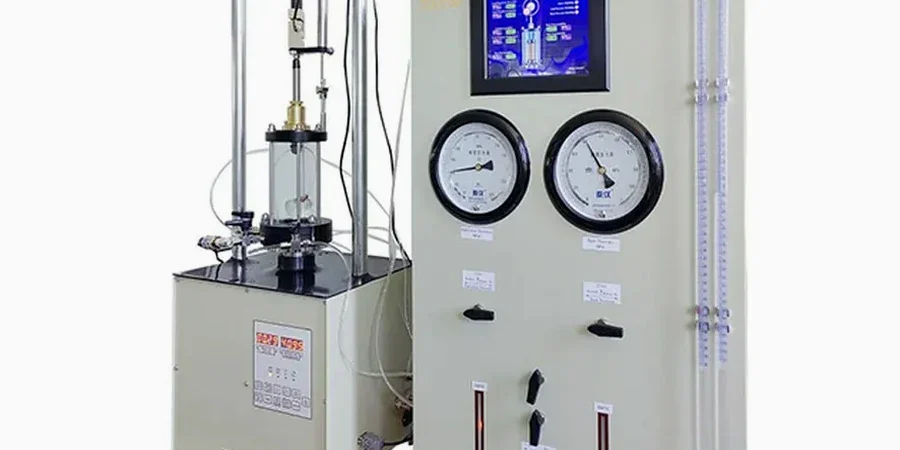
When a project in Grand Rapids moves beyond routine site investigation, the conversation inevitably turns to the shear strength of the glacial sediments that lie beneath the city. The Grand River carved a valley through thick deposits of sand, silt, and clay left by the Lake Michigan lobe, and while a standard SPT boring tells you something about density, it cannot measure the effective stress parameters that govern how a foundation will actually behave under load. For that, an advanced laboratory program becomes essential, and the triaxial test provides the engineered parameters—effective cohesion and friction angle—that West Michigan structural engineers need to model bearing capacity for footings, mat foundations, and deep excavations in the saturated sands and varved clays common to Kent County. Our laboratory runs consolidated-undrained triaxial shear with pore pressure measurement on Shelby tube samples recovered from sites as varied as the downtown Medical Mile corridor and the outwash plains east of the airport, delivering results calibrated to ASTM D4767 and D7181 in time for the foundation submittal package. We complement this with a grain-size analysis to confirm the Unified Soil Classification, and often pair it with an Atterberg limits determination when the sample exhibits plastic fines, because the drained versus undrained response depends heavily on whether the matrix is a lean clay or a clayey sand.
A triaxial test measures what a boring log cannot: the effective friction angle that controls how far a footing can mobilize shear resistance before the soil fails.
Site-specific factors
The contrast between the sandy lake plain on the west side of Grand Rapids and the clay-rich till uplands east of US-131 illustrates why a single friction angle assumption cannot be applied citywide. On a site near John Ball Park, the subsurface typically consists of clean medium sand extending 30 feet down, and a drained triaxial test on a reconstituted sample will yield a friction angle in the 34-to-38-degree range, perfectly adequate for a shallow footing designed under ASCE 7 load combinations. Four miles east in the Ada drift complex, the same depth reveals a stiff silty clay with occasional gravel lenses; an undrained triaxial test on that material may show a friction angle closer to 26 degrees with a small but non-zero effective cohesion intercept. The risk of skipping the triaxial program is that a designer borrows a generic bearing capacity factor from a textbook and overestimates the allowable soil pressure, leading to settlement that appears gradually over the first two winters as the clay consolidates under the building's dead load. The Michigan Building Code references IBC Chapter 18, which requires that shear strength parameters used in foundation design be based on laboratory testing of representative undisturbed samples when the structure falls into Seismic Design Category C or higher—a threshold that much of Kent County meets. Our laboratory's accreditation under the AASHTO re:source program and our adherence to the AASHTO R 18 quality system ensure that every triaxial report is defensible during the peer-review process that accompanies a major Grand Rapids development permit.
FAQ
How much does a triaxial test program cost for a Grand Rapids commercial project?
A typical triaxial testing program for a Grand Rapids commercial building, involving three CU specimens at different confining pressures with pore pressure instrumentation and a complete Mohr-Coulomb report, ranges from US$2,120 to US$2,830 depending on the number of confining stages and whether drained (CD) tests are also required on granular layers. The final scope and fee are determined after we review the boring logs and sample condition.
What type of soil sample is required for a reliable triaxial test?
We require undisturbed samples obtained with a thin-wall Shelby tube or a block sample from an excavation. Disturbed split-spoon samples from an SPT operation are not suitable for triaxial testing because the remolding destroys the in-situ fabric and effective stress history that the test is designed to measure. For Grand Rapids sites, where the critical layer is often a soft silt or stiff clay, sample recovery must exceed 85% and the tube must be sealed immediately with wax to preserve moisture content.
How long does a consolidated-undrained triaxial test take in the laboratory?
The complete sequence for a single CU triaxial specimen—saturation, consolidation, and undrained shear—typically requires five to seven working days for fine-grained glacial soils. Consolidation time depends on the soil's coefficient of consolidation; the varved clays found in some Grand Rapids borings can require 48 hours of consolidation alone before the shear phase begins. We carry out an estimated turnaround when we receive the samples and can often prioritize testing to align with a foundation submittal deadline.
What is the difference between a triaxial test and a direct shear test for foundation design?
The direct shear test forces failure along a predetermined horizontal plane and cannot measure pore pressure during shear, so it yields total-stress parameters that are less reliable for effective-stress analyses. The triaxial test allows the soil to fail along its natural plane of weakness, measures pore pressure throughout the test, and provides the effective cohesion and friction angle that IBC Chapter 18 requires for bearing capacity calculations when groundwater is present. For the saturated soils common in Grand Rapids, the triaxial test is the preferred method.
Do I need a triaxial test if an SPT boring already shows N-values for my site?
SPT N-values carry out an index of relative density or consistency, and empirical correlations can estimate a friction angle with a range of plus or minus 5 degrees, which is too wide for a foundation design where settlement tolerance is tight. The triaxial test measures the actual effective stress parameters of the undisturbed soil at your Grand Rapids site, removing the guesswork and giving the structural engineer a defensible number for the bearing capacity analysis required by the city's plan review process.