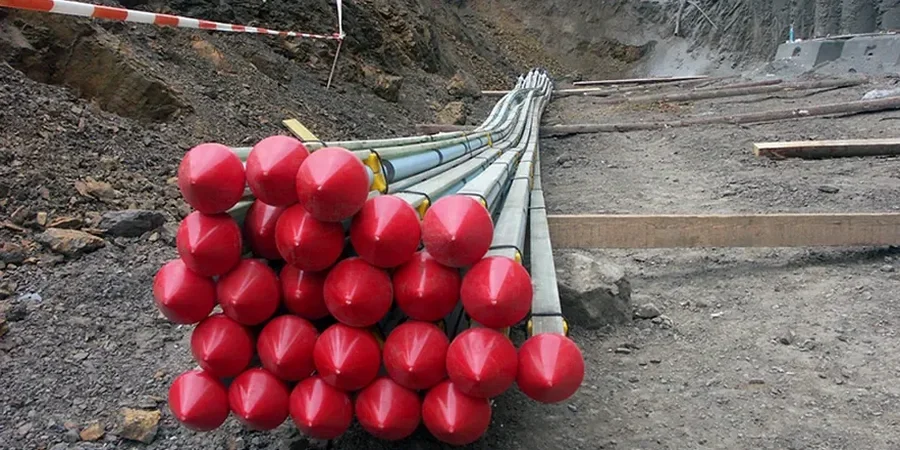
Anchor design in Western Michigan requires a thorough understanding of the layered glacial outwash and lacustrine clays that define Grand Rapids' subsurface. The IBC and ASCE 7 set the baseline, but it is the local site conditions — the dense tills and the sensitive, water-bearing sand lenses found across Kent County — that dictate whether an active or passive anchorage solution proves optimal. When a project on the Grand River floodplain demands a deep excavation just feet from existing foundations, the tieback capacity must be verified against the actual bond stress achievable in these deposits, not just assumed from generalized correlations. Our laboratory performs this verification by testing the interface between the grout body and the surrounding soil under conditions that replicate the in-situ stress state, a step that becomes especially critical when soft-ground tunneling or adjacent deep excavations impose strict limits on lateral movement.
A well-executed anchor design in Grand Rapids hinges on the bond stress between grout and the region's layered glacial tills, not on the steel tendon strength.
Site-specific factors
The freeze-thaw cycles that characterize Grand Rapids' climate, with temperatures swinging from sub-zero winter lows to humid summer highs in the mid-80s, impose a fatigue-like loading on the unbonded length of active anchors that is often underestimated. When the frost line penetrates three to four feet into the ground, the resultant heave can introduce unplanned tensile forces into anchor heads, while the saturated sands of the glacial outwash — common in townships like Plainfield and Wyoming — lose significant shear strength during spring thaw. Furthermore, the hydraulic connectivity between the Grand River and the shallow aquifer means that excavation dewatering can induce settlement beyond the site boundaries. A passive anchor system that relies on soil arching may see its capacity degrade if this consolidation loosens the ground around the fixed length, a scenario we mitigate through detailed in-situ permeability testing and pore pressure monitoring before lock-off.
FAQ
When does a Grand Rapids project need an active anchor instead of a passive one?
Active anchors become necessary when the tolerable lateral movement of a shoring wall or abutment is less than roughly half an inch — a common constraint in the dense urban blocks of downtown Grand Rapids. By pre-stressing the tendon to 80–100% of the design load before the next excavation lift, you eliminate the slack that a passive system requires to mobilize. In the loose to medium-dense sands found in the floodplain, this early lock-off prevents the rapid stress relaxation that could otherwise cause adjacent pavement to crack.
What does anchor design verification cost for a typical Grand Rapids project?
For a standard verification program involving sacrificial test anchors, performance tests, and lab-based grout-soil interface analysis, fees generally range from US$1,180 for a single-anchor diagnostic to US$4,210 for a comprehensive program covering multiple soil strata on a mid-sized commercial site. The cost depends on the number of unique soil units requiring bond stress characterization.
How do you account for the variable clay content in Grand Rapids tills when designing anchors?
The tills across Kent County are not uniform; some are sand-dominant and free-draining, while others are clay-rich and prone to creep under sustained load. Our approach involves sampling the specific stratum at the bond zone depth, running Atterberg limits and undrained shear strength tests, and then performing a staged creep test on a representative anchor. If the creep rate exceeds 0.04 inches per log cycle of time, we adjust the bond length or reduce the design load to maintain long-term stability.